
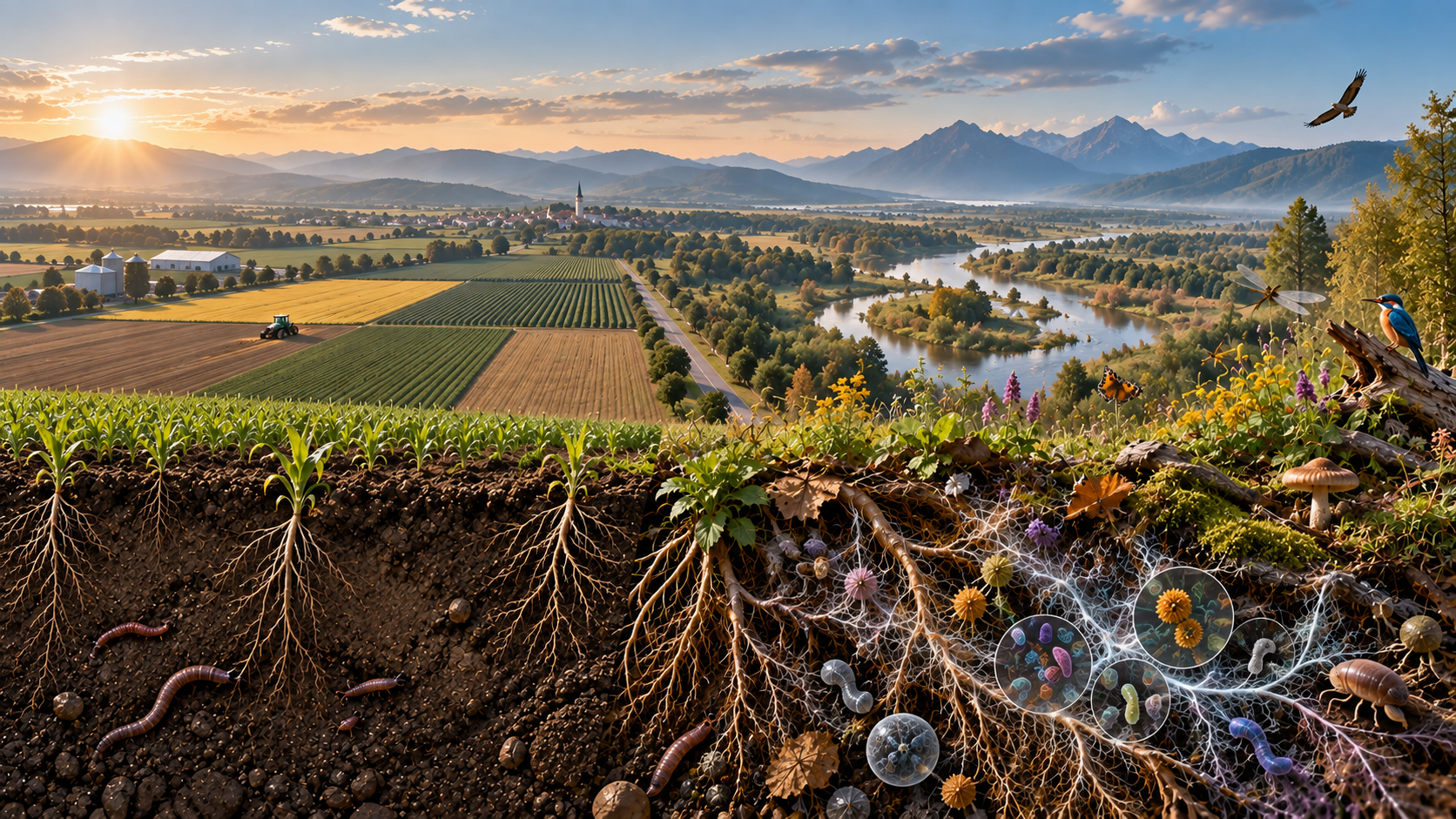
We shape landscapes ever more strongly around our needs. What serves no recognisable purpose can quickly appear dispensable. Yet this contains a hidden error: we judge species by functions we already know, even though their capacities and relationships remain only incompletely understood.
Imagine a landscape consistently tailored to human purposes. Fields grow what we want to eat or use economically. Forests provide timber. Rivers are shaped so that water is available and floods are kept as manageable as possible. Roads connect settlements, commercial areas provide jobs, and green spaces fulfil defined functions.
The more consistently we optimise such a landscape, the more plausible a provocative question becomes: why do we still need so many species?
Growing maize does not require every species
If we consider only one function, not every species present is indispensable for it. A maize field does not need the biodiversity of a natural or near-natural landscape in order to produce maize. Biodiversity research likewise shows that individual ecosystem functions can display saturating relationships with species richness. When several functions are considered, more species may be required because different species can support different functions.[1]
This is where the hidden error begins. Before deciding which species we “need”, we have already decided what we need them for. Use determines the function. The function then determines what appears useful or superfluous to us.
How much of the ecosystem can we leave out?
The objection can be taken further. If a particular form of production really does not require the full biological diversity of a landscape, can we not replace more and more ecological prerequisites technologically?
“Urban farming” primarily describes the urban context, not the degree of technical control, and covers very different systems – from community gardens to technically controlled vertical farms. According to a systematic review, community gardens are among the forms of urban agriculture and green infrastructure that can provide a particularly diverse range of ecosystem services.[2]
In technically controlled indoor or vertical farming, whether urban or not, light, temperature, humidity, water and nutrient supply can be deliberately controlled or provided technologically. For certain crops, production can thus be largely decoupled from weather and site conditions.[3]
The prerequisites for production do not disappear. Lighting, climate control, pumps and control systems require energy and technical infrastructure; essential prerequisites may therefore lie outside the farm.[3]
A vertical farm does not have to reproduce a complete ecosystem. Its purpose may simply be to produce lettuce or herbs. But what happens when we draw the system boundary much more widely?
What Biosphere 2 made visible
How far can a complex ecosystem be artificially recreated and controlled? That is precisely what Biosphere 2 explored on an extraordinary scale in Arizona in the early 1990s. The largely airtight, glazed facility brought together artificially assembled habitats, soils, water, atmosphere, plants and animals.[4][6] Eight people lived inside it during the first two-year mission. Its internal agricultural system supplied about 80 percent of their nutritional needs.[5]
It would therefore be too simplistic to dismiss Biosphere 2 as a failed experiment. For our question, what matters are precisely the unexpected interactions that became visible in this largely closed system.
During the first 16 months, atmospheric oxygen fell from about 21 to 14 percent. Investigations attributed much of the oxygen loss to microbial respiration in soils heavily enriched with organic matter. Yet the resulting carbon dioxide did not remain entirely in the atmosphere: some reacted with the concrete used in the structure to form calcium carbonate.[4]
A biological process in the soil, the composition of the atmosphere and the chemistry of a building material were therefore directly coupled.
Biosphere 2 was designed to be largely closed to material exchange; energy, however, was supplied from outside.[6] When oxygen had fallen to about 14 percent after roughly 16 months, oxygen was also added from outside.[7]
The experiment therefore does not show that humans cannot build artificially organised ecosystems. It illustrates something more interesting for our original question: in a largely closed system, interactions between soil, atmosphere and building materials can become visible that are easily left outside the field of view when individual functions are optimised.
Yet even this leaves a second uncertainty. We do not only understand the relationships within a complex system incompletely. We also know only part of the capabilities of its individual organisms.
A bacterium and a plastic bottle
In 2016 researchers identified the bacterium Ideonella sakaiensis. Under the laboratory conditions studied, it can degrade PET and assimilate the breakdown products.[8] This does not solve the global plastic problem. But it illustrates how difficult it is to predict which biochemical capabilities of an organism may one day become significant to us.
When is a species redundant?
Species may be similar with respect to a particular function. In ecology, the term functional redundancy has long been used for this. Eisenhauer and colleagues propose speaking more precisely of “functional similarity” and specifying function, environmental conditions and context.[9] Fischer and de Bello counter that functional redundancy has distinct value as an ecological concept.[10] Similar species may perform a comparable function under present conditions and still respond differently when conditions change.
Ecosystems also perform more than one function. The measured relationship between biodiversity and multifunctionality depends on which functions are included and how many are considered.[11] The analytical method also affects the measured relationship.[12]
“We do not need this species” therefore initially means only: we do not need it for a particular known function under particular known conditions.
The biological space of possibilities
Within the IPBES framework of Nature’s Contributions to People, maintenance of options (NCP 18) describes the capacity of ecosystems, habitats, species or genotypes to keep options open for a good quality of life.[13] This article calls the totality of these options a “biological space of possibilities” – a journalistic shorthand, not an established scientific term.
This does not mean every species must someday prove useful to humans. The key issue is the limit of our knowledge. We do not even know the exact number of species on Earth. Mora and colleagues estimated about 8.7 million eukaryotic species in 2011 (± 1.3 million, standard error) while emphasising the uncertainties of indirect estimation.[14]
When a species disappears, we do not necessarily lose a known indispensable function. But biological possibilities and relationships can be lost before we even know that they exist.
This limit to our knowledge does not mean that every species must be given equal weight in every circumstance or that conservation can do without priorities. Decisions about protection, use and competing objectives remain necessary. They should simply not rest on the broader assumption that the absence of a function recognisable today makes a species dispensable.
This says nothing yet about any intrinsic value species may have. This article deliberately addresses only the narrower, instrumental question of whether our present knowledge allows us to infer that a species is dispensable.
The blind spot of the standardised landscape
The more a landscape becomes a standardised production surface, the more our chosen use determines which functions are visible and relevant. “Not required for our present use” can quietly become “not required”. The latter does not follow from the former.
Technically controlled production systems do not alter this conclusion: they can isolate and stabilise individual functions without thereby replacing the relationships and possibilities of a larger living system.
We may be standardising the Earth faster than we are learning about its biological possibilities.
So do we need every species?
Science offers no simple answer. It would be too easy to claim that every species is indispensable for every conceivable function. The opposite claim is at least as problematic.
Perhaps the decisive biodiversity question is therefore not: How many species do we need?
But: How do we know which species we do not need?
As long as we cannot answer that question, the claim that a species is dispensable reaches further than our knowledge.
Sources and notes
- Hector, A.; Bagchi, R. (2007): Biodiversity and ecosystem multifunctionality. Nature 448, 188–190. ↩
- Evans, D. L.; Falagán, N.; Hardman, C. A.; Kourmpetli, S.; Liu, L.; Mead, B. R.; Davies, J. A. C. (2022): Ecosystem service delivery by urban agriculture and green infrastructure – a systematic review. Ecosystem Services 54, 101405. ↩
- Engler, N.; Krarti, M. (2021): Review of energy efficiency in controlled environment agriculture. Renewable and Sustainable Energy Reviews 141, 110786. ↩
- Severinghaus, J. P.; Broecker, W. S.; Dempster, W. F.; MacCallum, T.; Wahlen, M. (1994): Oxygen loss in Biosphere 2. Eos, Transactions American Geophysical Union 75(3), 33–37. ↩
- Silverstone, S. E.; Nelson, M. (1996): Food production and nutrition in Biosphere 2: Results from the first mission September 1991 to September 1993. Advances in Space Research 18(4–5), 49–61. ↩
- Dempster, W. F. (1999): Biosphere 2 engineering design. Ecological Engineering 13, 31–42. ↩
- Allen, J. P.; Nelson, M. (1999): Biospherics and Biosphere 2, mission one (1991–1993). Ecological Engineering 13, 15–29. ↩
- Yoshida, S. et al. (2016): A bacterium that degrades and assimilates poly(ethylene terephthalate). Science 351, 1196–1199. ↩
- Eisenhauer, N. et al. (2023): Reconsidering functional redundancy in biodiversity research. npj Biodiversity 2, 9. ↩
- Fischer, F. M.; de Bello, F. (2023): On the uniqueness of functional redundancy. npj Biodiversity 2, 23. ↩
- Meyer, S. T. et al. (2018): Biodiversity–multifunctionality relationships depend on identity and number of measured functions. Nature Ecology & Evolution. ↩
- Gamfeldt, L.; Roger, F. (2017): Revisiting the biodiversity–ecosystem multifunctionality relationship. Nature Ecology & Evolution. ↩
- Faith, D. P. (2021): Valuation and Appreciation of Biodiversity: The “Maintenance of Options” Provided by the Variety of Life. Frontiers in Ecology and Evolution 9:635670. ↩
- Mora, C. et al. (2011): How Many Species Are There on Earth and in the Ocean? PLOS Biology 9(8): e1001127. ↩
This article, including the accompanying AI-generated image, is licensed under CC BY-NC-SA 4.0. Structure and parts of the wording were developed with the assistance of AI (GPT, OpenAI). Editorial responsibility: Hans Leo Bader.